
By Conor S. Brandt, Content Coordinator
In October, 1776, hundreds of Americans crewed a fleet of four captured vessels and over a dozen hastily-constructed ships, intent on defending Lake Champlain against the invading British armada in what would be known as the Battle of Valcour Bay. The boats they built were ramshackle and haphazard, made from whatever materials they could get their hands on – including timbers they captured during the invasion of Canada in 1775.
It was with this hastily put-together fleet that Benedict Arnold hoped to delay the British invasion as long as he could. He’d have his work cut out for him. In October there were more than thirty English ships sailing south on Lake Champlain, intent on destroying the Patriot fleet[1].
As our region commemorates the 250th anniversary of the Battle of Valcour Bay this weekend, we wanted to take a closer look into the variety of ships that the Patriots crewed in 1776; from what types of ships were in the fleet and how they were acquired (or built) to how they planned to use them. Read on!
Gunboats
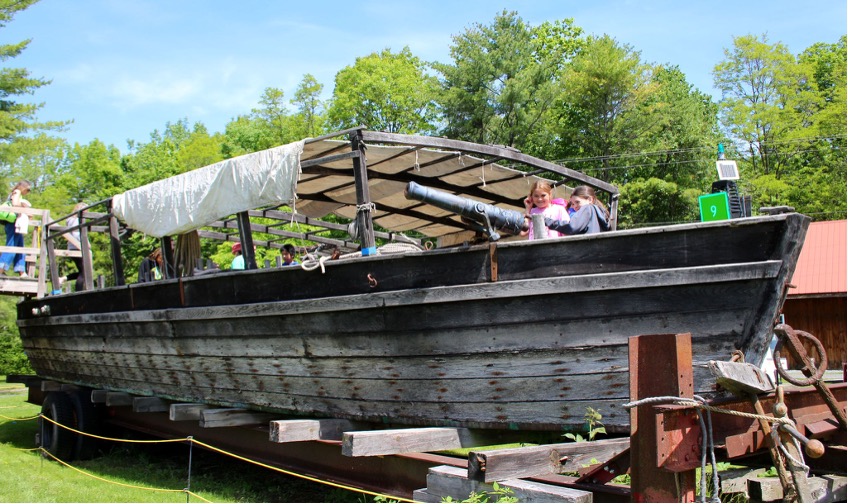
Image: The replica gunboat Philadelphia II on display at Lake Champlain Maritime Museum with steps for visitors to climb aboard.
The majority of the vessels built by laborers at Skenesborough, NY (modern day Whitehall) were considered gunboats. Eight were built and all eight fought at the Battle of Valcour Bay. They were cheap and easy to build – the Patriots could construct one in only three weeks – and didn’t require as many sailors to crew them as the larger vessels in the Patriot fleet did[2].
While gunboats were easy to build, they had a variety of issues. They were armed with three cannons and six to eight swivel guns, but they weren’t arranged in a broadside pattern, where cannons lined the ship’s hull so each side could fire together in a single volley. Instead, the gunboats had one cannon installed on the bow, one on the starboard side, and one on the port side. This meant that if there was a British ship bearing down on the gunboat, only one of the three cannons could fire back.
These gunboats were also difficult to sail. They were built with two square sails, which meant that unless the wind was coming directly from the stern of the ship, the combination of a crosswind and the flat bottom of the boat would cause it to go sideways instead of forward. Because of this, the crews used their oars to row the gunboats to their destination.
The eight gunboats in the Patriot fleet were: Providence, Spitfire, Connecticut, Jersey, New Haven, Boston, Philadelphia, and New York. Of the eight, only New York would survive the coming clash with the British.
Row Galleys
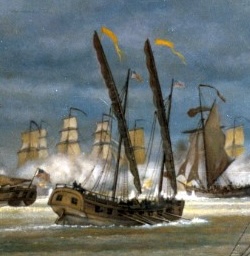
Image: Detail of a row galley from “Battle of Valcour Island,” V. Zveg, 1975. Naval History and Heritage Command.
After arriving to take command of the Patriot fleet on Lake Champlain, Benedict Arnold pushed for the laborers to begin building larger vessels with powerful broadsides. These ships would, hopefully, allow the outnumbered Patriots to more ably fight off the powerful British navy. Soon after Arnold arrived, the workers at Skenesborough began building row galleys, 70-foot long vessels that could carry 10-12 cannons arranged in a broadside pattern, with half the cannons lining either side of the ship.
They were outfitted with lateen sails which allowed them to better harness the wind to sail compared to the gunboats and also had oars that the crew used to row the ships.
Four row galleys were planned to be built, but by the Battle of Valcour Bay only three had been finished: Congress, Trumbull, and Washington. The last row galley, Gates, would be finished far too late to help at Valcour Bay. In addition to the row galleys, there was also a smaller cutter galley in the Patriot’s fleet, Lee, built from timbers taken by the Patriots during their advance into Canada the previous year.
Of the three Patriot galleys who fought in the Battle of Valcour Bay, only one, Trumbull, managed to escape. Washington was captured by the British and Congress was destroyed by Arnold after he was forced to abandon it. In addition, Lee was run aground during the battle.
Sloops & Schooners
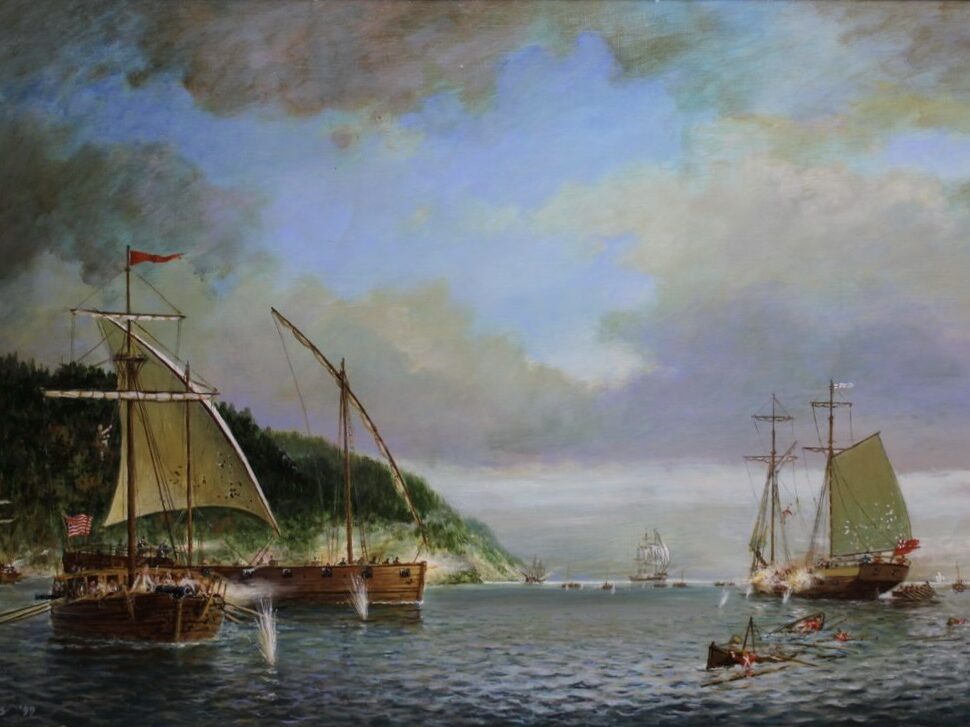
Image: Battle of Valcour Island, Ernest Haas, 1999, Acrylic on Panel, Lake Champlain Maritime Museum Collection.
There were four other vessels in the Patriot fleet that weren’t considered either galleys or gunboats. Three of them, Royal Savage, Revenge, and Liberty, were schooners – a vessel with two fore-and-aft sails and a headsail. Schooners had become a very common type of vessel in Colonial America in the second half of the 18th century. The last, Enterprise, was considered a sloop – a vessel with a single mast and fore-and-aft rig[3].
These vessels had been acquired in a variety of ways; Liberty was originally a loyalist landowner’s personal vessel before its capture by the Patriots. Enterprise, Revenge, and Royal Savage were all British vessels, captured and repurposed by the Patriots during their invasion of Canada in 1775.
To defend Lake Champlain in 1776, the Patriots used their schooners in a variety of ways: Enterprise served as a hospital ship for the Patriots, while Revenge was considered useful for the eight cannons it carried. Finally, Liberty was used as a messenger ship and missed the Battle of Valcour Bay because it was away from the fleet, at Fort Ticonderoga acquiring supplies.
Royal Savage was initially used as Arnold’s flagship. This changed once the row galley Congress was finished being built and Arnold transferred his flag there. After that Royal Savage was primarily utilized for its complement of 12 cannons.
While Liberty missed the battle entirely, both Revenge and Enterprise managed to escape. The schooner Royal Savage was lost when it ran aground during the fighting at Valcour Bay and was set ablaze.
The Fate of the Fleet on Lake Champlain
While Arnold’s fleet couldn’t defeat the formidable British force arrayed against them, they accomplished something just as important: they delayed the English advance South for a calendar year.
By the time the Patriot fleet was defeated at Valcour Bay, autumn had arrived and it was too late for the British to contemplate continuing their invasion. The work of patriot laborers, soldiers, and sailors throughout the summer and fall had bought the rest of America time to prepare their defenses in upstate New York where, in Saratoga, the tide of the war would be changed forever.
We’ve included a table below that lists all the ships that were a part of the Patriot fleet, as well as their type, how they joined the Patriot fleet and what happened to them by the end of 1776.
Patriot Ships on Lake Champlain
| Ship Name | Ship Type | How it Entered American Service | Fate by the end of 1776 |
|---|---|---|---|
| Providence | Gunboat | Built at Skenesborough, NY | Run aground at Arnold’s Bay and blown up to prevent its capture by the British |
| Philadelphia | Gunboat | Built at Skenesborough, NY | Sunk at the Battle of Valcour Bay |
| Spitfire | Gunboat | Built at Skenesborough, NY | Destroyed at Schuyler’s Island to prevent its capture by the British |
| Connecticut | Gunboat | Built at Skenesborough, NY | Run aground at Arnold’s Bay and blown up to prevent its capture by the British |
| Jersey | Gunboat | Built at Skenesborough, NY | Destroyed at Schuyler’s Island to prevent its capture by the British |
| New Haven | Gunboat | Built at Skenesborough, NY | Run aground at Arnold’s Bay and blown up to prevent its capture by the British |
| Boston | Gunboat | Built at Skenesborough, NY | Run aground at Arnold’s Bay and blown up to prevent its capture by the British |
| New York | Gunboat | Built at Skenesborough, NY | Survived the battle intact, escaped to Fort Ticonderoga |
| Trumbull | Row Galley | Built at Skenesborough, NY | Survived the battle intact, escaped to Fort Ticonderoga |
| Congress | Row Galley | Built at Skenesborough, NY | Run aground at Arnold’s Bay and blown up to prevent its capture by the British |
| Washington | Row Galley | Built at Skenesborough, NY | Captured by the British, later used as a British warship |
| Gates | Row Galley | Built at Skenesborough, NY | Built too late to participate in the fighting in 1776 |
| Lee | Cutter Galley | Built from timbers stolen from the British | Ran aground during the Battle of Valcour Bay |
| Enterprise | Sloop | Originally a British vessel, captured and turned into an American vessel | Survived the battle intact, escaped to Fort Ticonderoga |
| Royal Savage | Schooner | Originally a British vessel, captured and turned into an American vessel | Ran aground during the Battle of Valcour Bay and set aflame |
| Revenge | Schooner | Originally a British vessel, captured and turned into an American vessel | Survived the battle intact, escaped to Fort Ticonderoga |
| Liberty | Schooner | Originally the vessel of a loyalist landowner, captured and turned into an American vessel | Was at Fort Ticonderoga acquiring supplies during the Battle of Valcour Bay, survived 1776 intact |
[1]Seelinger, Matthew. “Buying Time: The Battle of Valcour Island.” On Point 3, no. 4 (1997): 4. http://www.jstor.org/stable/44608089.
[2] For a longer discussion on the American Gunboats on Lake Champlain check out this lecture with our Executive Director, Chris Sabick: https://www.youtube.com/watch?v=3xLSLqq0PDo.
[3] Evans, C.W. (2023). Some Notes on Shipbuilding and Shipping in Colonial Virginia.