
By Conor S. Brandt, Content Coordinator
With the 250th anniversary of the Battle at Valcour Bay having just passed, we thought it would be a good time to talk about some of the artifacts in our collection that would’ve been primarily used by soldiers or in a military context. This blog is a part of our Lost and Found blog series, where we highlight the artifacts we collect and preserve at the Museum, and talk about what they can tell us about the people who used them.
If you missed our last two blogs in this series, click here to read about artifacts we recovered from Valcour Bay, and click here to read about objects we recovered from Arnold’s Bay.
Powder Charge Scoop


This powder charge scoop is especially interesting to us because it displays some of the clever ways soldiers during the Revolution attempted to manage the risks involved when loading and carrying explosive materials.
During the American Revolution, artillerymen aboard military vessels would use a large scoop like this to load powder charges into a cannon. This artifact consists of a brass tube mounted to the end of a wooden handle. The tube is especially interesting, as brass was used specifically to avoid sparks igniting the powder prematurely, which could possibly cause a fatal explosion.
This is one example of the many ways that soldiers during the American Revolution worked to mitigate the risk of setting off an accidental explosion while manning their cannon. Unfortunately, safety measures taken by artillerymen to avoid accidental explosions did not always succeed. During the Battle of Valcour Bay, for example, a cannon aboard the gunboat New York exploded onboard, killing one man and injuring at least two others. Fatal accidents like this would’ve been on the mind of many artillerymen, probably as they loaded each charge.
Socket Bayonet


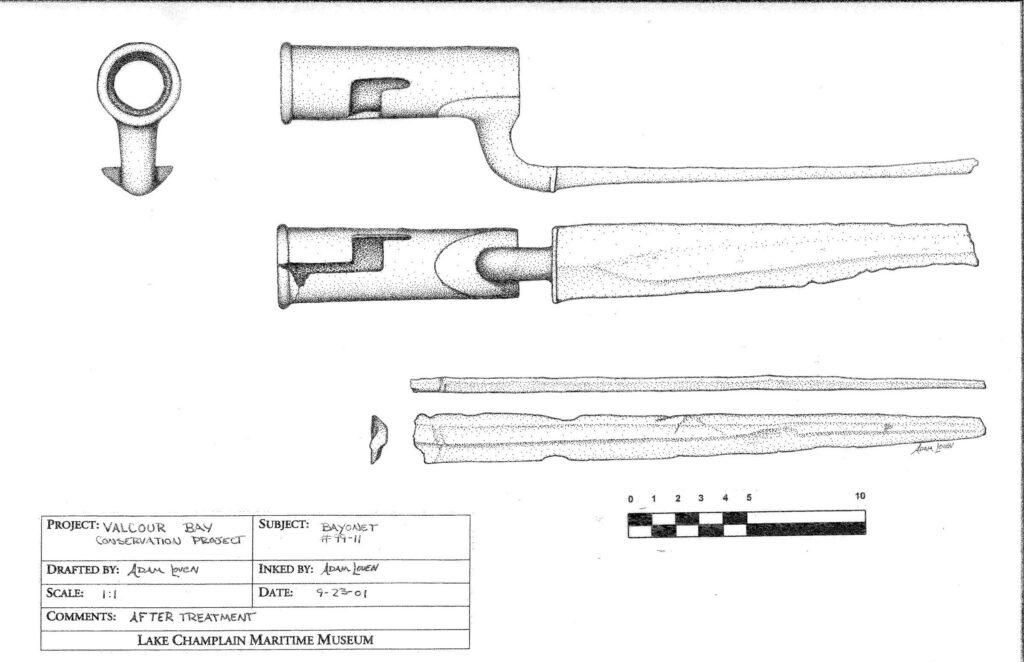
Recovered from Valcour Bay in 1999, this socket bayonet was believed to have been blown off of the Patriot gunboat New York when its cannon accidentally erupted during the Battle of Valcour Bay. Bayonets like this one would’ve been commonly carried by soldiers during the Revolution, as affixing a bayonet to the end of a musket allowed soldiers to turn their muskets into essentially a spear, which was useful when fighting in close quarters.
This artifact’s style suggests it was forged between 1735 and 1745, meaning it would’ve been decades old by the time it was carried to Valcour Bay. Another odd fact about this bayonet is that it was pounded flat. Most bayonets of this type had a triangular blade.
This bayonet, decades old and with a flat blade unlike others of its type, reveals the nature of the American Revolution on Lake Champlain. Because of the lack of supplies, soldiers often had to make do with whatever they had on hand, leading to situations where decades old, abnormal bayonets like this one were carried into battle.
4.5″ Barshot

This is a 4.5” barshot that would’ve been loaded into a cannon and fired at enemy ships. It was an important tool in the arsenal of anyone who planned on fighting enemy vessels. After being shot, the barshot would begin to spin, making it effective at cutting rigging and putting large holes in sails, effectively immobilizing the enemy and making their vessel easy to capture.
This barshot is a fascinating discovery. We covered a few examples of this barshot alongside many traditional cannonballs from the artifact scatter at Valcour Bay (click here to see an example of this standard round shot). The barshot itself was likely made by cutting a six pound cannon ball in half and welding a bar between the halves, a simple way to utilize a cannonball in a very different way!
Thanks for joining us!
These three objects tell us more about the tools and weapons that soldiers carried into battle, and shows us that the American Revolution on Lake Champlain was characterized by improvisation, danger and limited resources.
If you would like to take a closer look at these three objects, or any other objects in our collections, follow the links below to explore our digitized collections where we have archived many more stories!
- Link to the Powder Charge Scoop: https://hub.catalogit.app/lake-champlain-maritime-museum/entry/powder-charge-scoop?query=powder%20charge
- Link to the Socket Bayonet: https://hub.catalogit.app/lake-champlain-maritime-museum/entry/socket-bayonet?query=Socket%20Bayonet
- Link to the 4.5” Barshot: https://hub.catalogit.app/lake-champlain-maritime-museum/entry/4.5-barshot?query=4.5%22
- Link to all our digitized collections: https://hub.catalogit.app/lake-champlain-maritime-museum
PS We’re always looking for more information! If you have more context to share about any of these items, please don’t hesitate to reach out to us at info@lcmm.org.