
Sarah Ellen (Schooner)
Organization
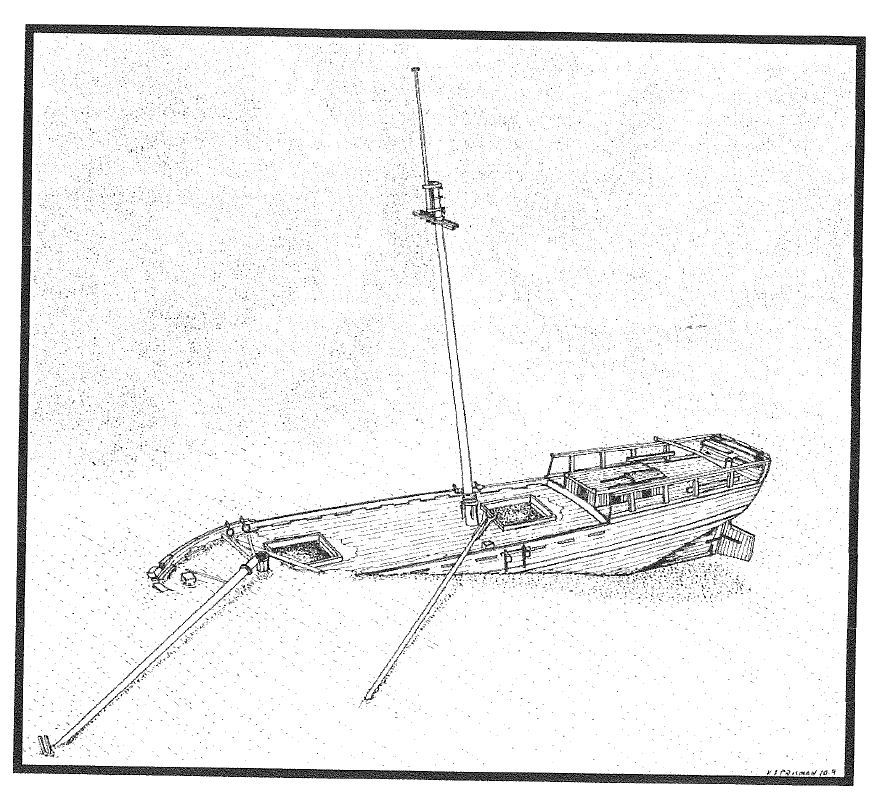
(from Museum Institutional Records) Vessel Name: Sarah Ellen Vessel Type: Lake Schooner Year Built: 1849 Builder: Daniel Wilcox Length: 73 feet Width: 15 feet 10 inches Depth: 4 feet 4 inches The schooner Sarah Ellen, located and investigated in 1989, is a deep-water wreck that offers a tantalizing link to Lake Champlain's little-known nineteenth century working-class sailing vessels and their builders. Hemenway' s Vermont Historical Gazetteer tells of Benjamin Boardman, a seafaring man from Norwich, Connecticut, who came to Burlington in 1788 "anticipating the necessity which must soon arise for boats upon the Lake." (1) Boardman brought along boat builder Daniel Wilcox from the esteemed shipbuilding center of New London, Connecticut. One of the earliest boat builders on Lake Champlain after the Revolutionary War, Wilcox was credited with continuing to build vessels in the New London style, using techniques that supposedly accounted for: the superior models of the sloops here, which will be observed are not like the heavy Dutch sloops of those days, in use upon the Hudson, but like the clipper vessels which were built at New London, New Haven and Hartford, to sail to New York through the Sound, for passengers, before the days of steamboats. (2) Registered in 1849 at Alburgh, Vermont, Sarah Ellen was 73 feet (22.3m) in length, 15 feet 10 inches (4.8m) in breadth, and 4 feet 4 inches (1.3m) in depth. The vessel had one deck, two masts, no gallery or figurehead, and measured 40 22/95 tons. Sarah Ellen's original managing owner was Hiram C. Fisk, and its master was Abraham Gooley. (3) Hiram's sister Sarah E., born in 1824 and six years his younger, was the apparent namesake for the 1849 schooner. Sarah Ellen remained in Hiram Fisk's employ until 1853, when he sold the schooner to William Bush of Burlington, Vermont. The vessel was re-registered in 1856 due to the loss of her papers, with Bush listed as owner and master and Carlos Batchelder as master. Little is known of Sarah Ellen's working life, but the tragic circumstances of the schooner's loss are well documented. By 1860, the vessel was owned by J. Morse & Bros. and was working for S.W. Clark & Co., a quarry in Willsboro, New York. The quarry was producing stone blocks for the Vermont Central Railroad pier in Burlington, and the fully-laden Sarah Ellen was crossing the lake with the schooner Daniel Webster when the "distressing calamity occurred" on December 19, 1860. (4) Sarah Ellen was under the command of twenty-one-year-old Captain Henry Clay Hayward, who had been "brought up in the family of Mr. Clark of Willsborough [sic] and much respected." Henry Clay, as he was more familiarly known, had married Lucy Whitney of Burlington just that fall. The young couple was on board that day with a French crewman named Joe Laplante when the heavily laden schooner departed from Willsboro for Burlington. Newspaper reports stated that "the day was cold, the wind high, the spray dashing over the schooner and covering her with ice, the ropes all stiffened and unmanageable," and Sarah Ellen began to sink. The vessel's cause of distress was not known, although speculation that it either sprang a plank or took water into the forward hatch was considered "explanation enough and one or the other is doubtless the cause." The schooner began to settle at the head and sank in ten minutes. The Burlington Daily Free Press provided a gripping account of the attempted rescue of Sarah Ellen's three passengers: The persons on board were Capt. Hayward and his wife and one hand, a Frenchman. The three succeeded on the sinking of the schooner, in saving themselves for the time being by the small boat. The disaster was seen by the schooner Daniel Webster, also in the employ of Messrs. Clark, which bore down at once to the rescue of the persons in peril. They were seen, as the Daniel Webster drew near to them, clinging to the underside of the boat, which had capsized and was covered with ice. Unfortunately the yawl of the Daniel Webster was also so filled and covered with ice that it could not be used, and the attempt was made to approach and save them with the schooner. This was but partially successful. The Frenchman was seized and drawn to the deck of the schooner, while the shock as the larger vessel struck the small boat, shook Captain and Mrs. Hayward from their uncertain hold upon it, and they drowned before the Daniel Webster, which had swept by them, could be put about and again reach them. They were seen floating on the water for nearly five minutes, Mr. Hayward supporting his wife, when she sank, and in about a minute after her husband followed her to a watery grave. (5) The next day, the newspaper chastised Mr. Clark, owner of the Willsboro quarry, saying that "two vessels loaded with stone should attempt to cross the lake in a gale, or to sail at all with nothing more serviceable in the way of small boats, seems incredible" (BDFP 12/20/1860). With modem hindsight, it seems of further irony that Sarah Ellen sank while carrying stone to build the railroad, the mode of commercial transportation that led to"the decline and ultimate demise of Lake Champlain's wooden merchant fleet. The newspaper reported after the sinking that "the attempt to recover the bodies of Mr. and Mrs. H will be made, but with small prospect of success, as the water is deep and the spot where they sank cannot be very nearly determined. (6) In actuality, the wreck of the schooner, far below the surface, was not located for 140 years, and it will rest forever down by the head on the soft bottom of Lake Champlain. Historical Post Script. In 2008, Darcy Hale, from Willsboro, NY joined the LC:M Board of Directors. Darcy and her husband Bruce live on the Clark Quarry property and located a collection of diaries and early documents relating to the family and their quarry operations. After the death of his parents, Henry Clay Hayward had been adopted by Orrin Clark and his wife Mary. In being taken into the family, he became the step brother of Solomon Clark and stepbrother-in-law of Rhoda Clark. In the aftermath of the tragic loss of Henry Clay and his new bride Lucy Ann Whitney, Rhoda Clark made the following entry into her diary. Wednesday 19 December [1860] "Early this morn Solomon started on boat of the D [aniel] Webster for Burlington and Henry Clay on board the Sarah Ellen All from our wharf On board the Sarah Ellen was Capt Clay and wife and one hired man. They started 20 minutes before the Webster and ran a little beyond 4 brothers. And Sarah heavy loaded with stone on old lady boat and a heavy sea running left the crew in the water with a small gale wind was soon upset. The Webster came up in about 15 minutes and could do but little to save the perishing ones their yawl [boat] being full of water and.froze hard Solomon worked hard and long as chance would permit but save only one. Hemy and his wife were lost. The man being the first and only one to be got off After all was over the boat [D. WebsterJ went on her way to Burlington. " Thursday 20, December (1860] "At 10:00 at eve the dreadful news came to us. Solomon came home on (!lJe of Mr. Frisbies boats. The nei.vs came like heart rending words to us especely [sic} to his Mother." (1) (Vol. 1, 1868) (2) (Hemenway 1868: Vol. I, p. 688 (3) (Enrollment Papers, National Archives). (4) (BDFP, 12/19/1860). (5) (BDFP, 12/19/1860). (6) (BDFP, 12/19/1860)
Boat